


Small Team, Big World: Lessons from Building an Indie Game from Scratch

Every game starts somewhere. Ours started as a single idea.
At TooSix Media Group, we've spent over a decade building a multilingual voice casting agency and recording studio in Seoul - helping other people's stories come to life through voice. So when one idea for an original game world began taking shape internally, it felt like a natural next step: what if we told a story of our own?
That idea became Apocalypto: Columbra, and what started as a concept in one person's head is now being developed by a team of four. We're still early in the process - no launch date, no trailer drop, nothing to announce yet. But we've learned enough in these early stages that we think it's worth sharing, especially for anyone else out there considering building something with a small team and limited resources.
Here's what the process has actually looked like so far.
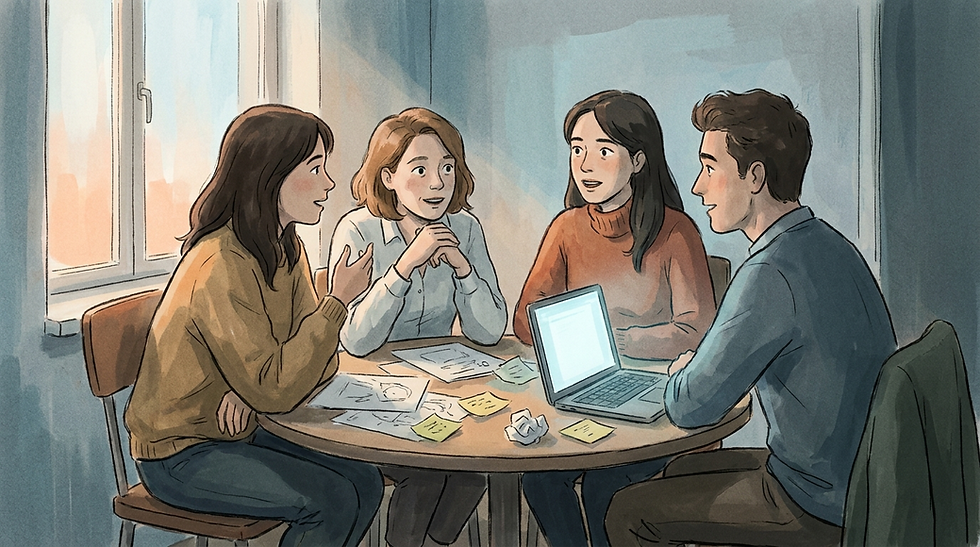
An Idea Doesn't Need a Big Team to Start
One of the biggest myths around game development is that you need a full studio before you can begin. A writers' room. A dedicated art department. An engineering team with years of shipped titles behind them.
The truth is, most games - even ones that eventually become massive - start with one person and a notebook. Ours did too. Before there was a team, there was a concept: a world, a tone, a handful of characters who felt real enough to build a story around.
If you're an aspiring creator sitting on an idea, waiting until you have "enough" people or "enough" resources to start, our honest advice is: don't wait. The idea is the hardest part to manufacture. Everything else - team, tools, budget - can be built around it once it exists.
Small Teams Move Differently Than Big Ones
Once an idea becomes a real project, the next challenge is assembling the right people - not the most people.
Working with a team of four means everyone wears more than one hat. There's no dedicated department for every task; the same people who are shaping the story are also thinking through worldbuilding logic, characters, and how the pieces fit together as a cohesive whole. That comes with real constraints. Fewer hands means slower output on any single front, and prioritization becomes a constant, active decision rather than something delegated down a chain of command.
But there's an upside that's easy to overlook when you're focused on the limitations: small teams move with less friction. There's no waiting on five layers of approval to test an idea. If something isn't working, the whole team knows it within a conversation, not a meeting cycle. Decisions that might take weeks in a larger studio can happen in an afternoon.
For a small team, speed of iteration is one of the few genuine advantages you have over larger, better-resourced competitors. It's worth protecting.
The People Matter More Than the Headcount
We've been fortunate that everyone working on Columbra is there because they want to be - not because it's an assigned task on a list. That distinction shapes the work more than people expect.
When a team is small, every person's creative fingerprint ends up woven into the final product in a way that's harder to achieve at scale. There's no single "art vision" handed down from above that everyone else executes - there's a genuine back-and-forth where ideas get shaped by whoever's in the room. It makes for a slower, messier process at times. It also makes for a project that feels distinctly its own, rather than assembled from a template.
If you're building a small team of your own, our biggest piece of advice is this: prioritize people who are genuinely excited about the idea over people who simply have the right resume. Skills can be developed or supplemented. Genuine investment in the project is much harder to manufacture after the fact.
Worldbuilding Before Everything Else
One decision that's shaped our process more than any other: we invested heavily in worldbuilding before touching production.
It's tempting, especially with a small team eager to see progress, to jump straight into building - whatever "building" means for your project. But a world without established rules, history, and internal logic tends to fall apart under its own weight the moment you start testing it against real scenes, real characters, or real mechanics.

For Columbra, that meant spending real time on the bones of the world before deciding on the shape of the game itself: who the factions are, what they want, how power moves through the world, and why the player's presence in that world matters. It's slower, less visually exciting work than concept art or prototyping. But it's also work that pays off every time a new decision needs to be made later, because there's already a foundation to check it against.
If you're early in your own project, resist the pull to skip straight to the fun, visible parts. The invisible scaffolding is what makes everything built on top of it hold together.
Play to Your Actual Strengths
Every small team has real constraints - money, headcount, technical expertise, time. Pretending those constraints don't exist doesn't make a project succeed; it just makes the eventual reckoning more painful.
What's worked better for us is being honest about where our strengths actually are, and leaning into them instead of trying to compete evenly on every front. TooSix's roots are in voice, in multilingual production, in storytelling that has to land across different languages and cultures. Those aren't incidental skills - they're a genuine head start for a narrative-driven project, even if other parts of development (like the technical build) are newer territory for the team.
Every small studio has some version of this: an existing skill, network, or capability that a bigger, better-funded team wouldn't necessarily have. Finding that advantage - and building your project around it rather than around what you think a "real" game studio is supposed to look like - tends to be a much stronger foundation than trying to check every box a big studio would.
It's Going to Take Longer Than You Want
This one isn't a lesson so much as an honest expectation-setter: a small, largely non-technical team building an original game is going to take longer than a well-funded studio with dedicated engineers, artists, and designers. That's simply the math of fewer hands doing more roles.
We've made peace with that reality rather than fighting it. The goal isn't to move as fast as a studio ten times our size - it's to keep steady, sustainable progress on something we actually believe in, without burning out the small group of people making it happen.
If you're in the early stages of your own project, give yourself permission to move at the pace your team can actually sustain. A slower, finished project beats a fast, abandoned one every time.

Where We Are Now
Apocalypto: Columbra is still early - we're not ready to share specifics on mechanics, release timing, or gameplay yet. But the world exists. The team exists. And what started as one idea is now something four people are actively building, piece by piece.
We'll be sharing more of this process as it develops - the wins, the setbacks, and everything in between. If you're building something of your own with a small team, we'd genuinely love to hear what's working (and what isn't) for you.
TooSix Media Group is a Seoul-based multilingual voice casting agency and recording studio, and the team behind Infinite Studios and the original game project Apocalypto: Columbra.


Comments